About us…
We are a young couple living in the beautiful, rural Perigord National Park of the Dordogne region, south west France.
We have always been amazed by bee’s, how they work, produce lovely natural products and are such a massive asset to the environment.
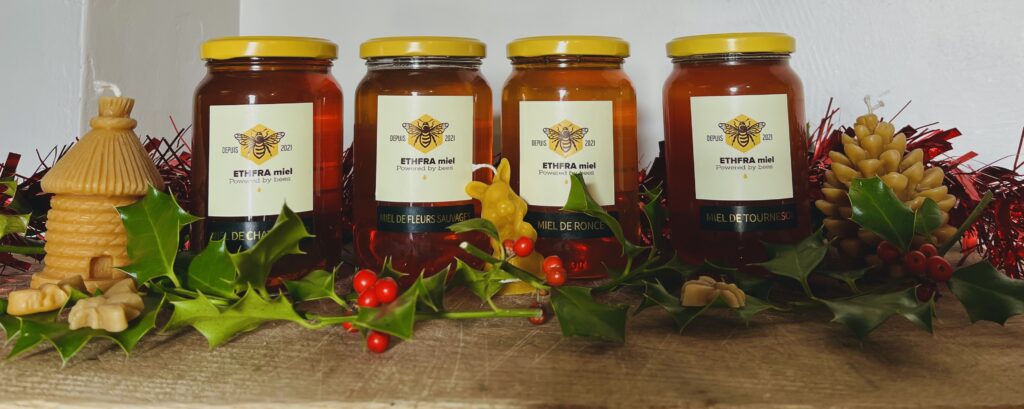
Our honey is produced in the Dordogne valley, by over 100 hives.
Our products are made with all natural, non-toxic materials, absolutely nothing is added. Candles are handcrafted with 100% pure beeswax!
Our bee’s produce our products with 100% love so we just won’t mess with them by adding fake materials.
Follow our journey here and on ETHFRA miel’s Facebook and Instagram
Learn with us about beekeeping, their ways, how they produce wax and honey, bee care and feeding throughout winter.
How to care for bees in the winter.
In the winter the bees spend most of their time inactive, although if we get a nice warm sunny day in January/February the bees will cleanse their hive including going to the toilet. Bees need to stay at a certain temperature all the time and when temperatures drop in the winter the bees will form a cluster and the worker bees shake their bodies to generate heat, the queen bee is in the center of the cluster “A loose inner core” which is the warmest part with temperatures reaching 30°C whereas the outside of the cluster “the dense outer mantel”
reaches around 12°C/8°C if the bees get too hot or too cold they will die, when the bees get too hot the worker bees place droplets of water on the capped brood and create a mist by fanning their wings to cool the hive down and to heat it up the bees fuel up on honey to keep their wings fit and healthy (people who keep bees that live in a colder climate somewhere like Canada they will bring their bees in the a barn to keep them warm through the winter months), also if it snows we have to clear the doors and make sure the bees are still getting a good air
flow, if the bees are lacking food (their winter stores) we give them bags of sugar, bee fondant and bee sirop because the bees only take liquids depending on the temperature (10 and below) the fondant is a mimic of when honey crystalizes in the hive.
In France we deal with varroa mites. The mites feed on bee larvae and pupae, resulting in deformation of the wings
and bodies of bees when they develop and emerge as adults. They also feed on adult bees. Around Christmas time we must do our mite treatments. There are effective naturally derived treatments to control mites: formic acid (organic), oxalic acid (organic), botanical oils of thymol formulations we personally use oxalic acid.
To see any of these things (behind the screens footage) go follow us on Instagram, TikTok or Facebook @ethframiel